
Roy Lichtenstein (American, 1923–1997)
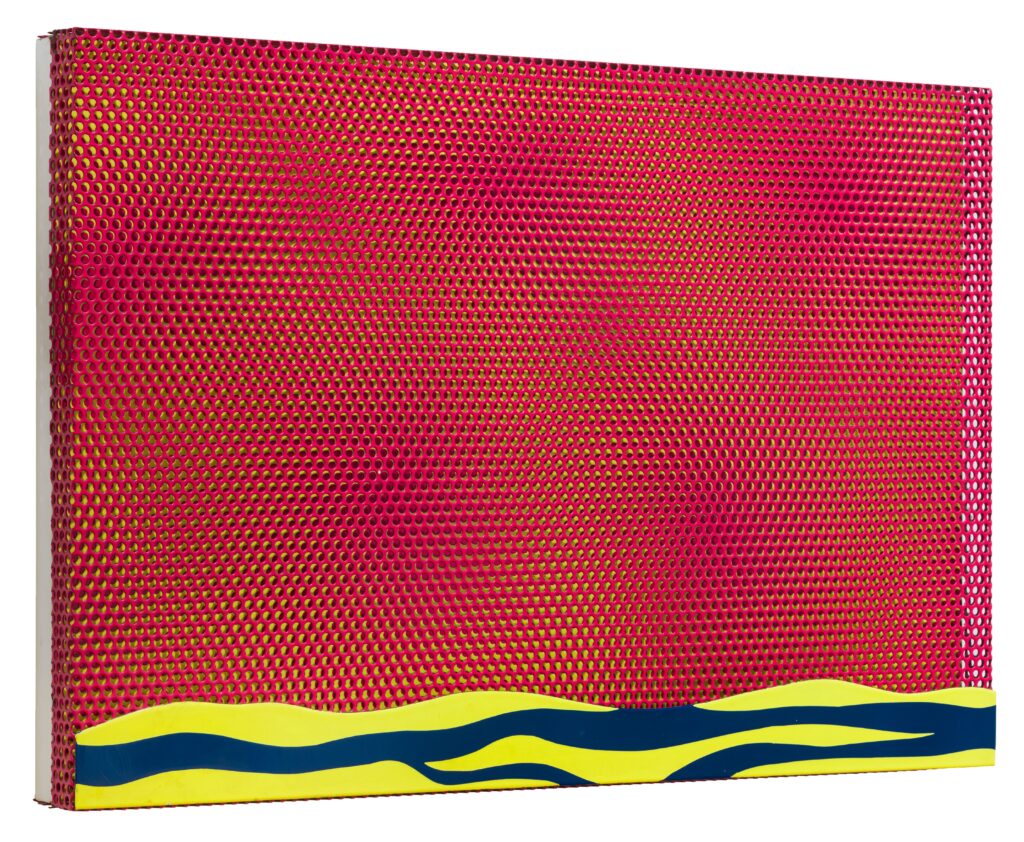
Perforated Seascape #2 (Red) Landscape, 1965
Porcelain enamel on perforated steel
Located at Belk Visual Arts Center, 1st Floor Hallway
Roy Lichtenstein is best known for his bold Pop Art creations from the 1960s, which often feature comic book heroines encapsulated in speech bubbles above fields of Benday dots. However, his work goes beyond pop imagery, often including sculptural forms and reimagined landscapes.
In Perforated Seascape #2 (Red) Landscape, Lichtenstein applies his Pop Art perspective to one of art history’s oldest subjects: the landscape. Instead of using ink on paper or oil on canvas, he employs porcelain enamel on perforated steel. The enamel shines like flashy commercial signage, while the steel features a precise rhythm of holes. This surface both conceals and reveals elements, suggesting water, light, and horizon, while also emphasizing its industrial construction.
Lichtenstein likely collaborated with Architectural Porcelain Fabricators, Inc., in Orangeburg, New York, for the enamel, and with Beckley Perforating Co., in Garwood, New Jersey, for the steel. This work blurs the lines between painting and sculpture, image and object, merging artistic vision with industrial process. A familiar landscape becomes mechanical, modern, and visually striking.
Perforated Seascape #2 (Red) welcomes visitors in the Belk Visual Arts Center, located in the first-floor hallway, with its striking and minimal composition. A few blue and yellow lines represent the horizon and waves, while the sky, set against a yellow backdrop, is constructed from vivid red enamel. The layered, glossy surface captures the light, creating a shimmering, almost cinematic effect. Its three-dimensionality adds a disorienting twist: as viewers move around the piece, the sky appears to shift and pulse, evoking an illusion reminiscent of Lichtenstein’s Pop Art paper works.
Up close, the artwork asserts itself as both an object and an image. Its perforated surface, industrial scale, and radiant finish give it a commanding and luminous presence. As viewers walk past, they observe how the piece transforms the hallway itself, turning the space into a stage for a constructed, modern horizon alive with color and texture.Lichtenstein’s seascape prompts viewers to rethink perception as a world filtered through culture, industry, and the artist’s meticulous vision.
– Emma McDonnell ’27