
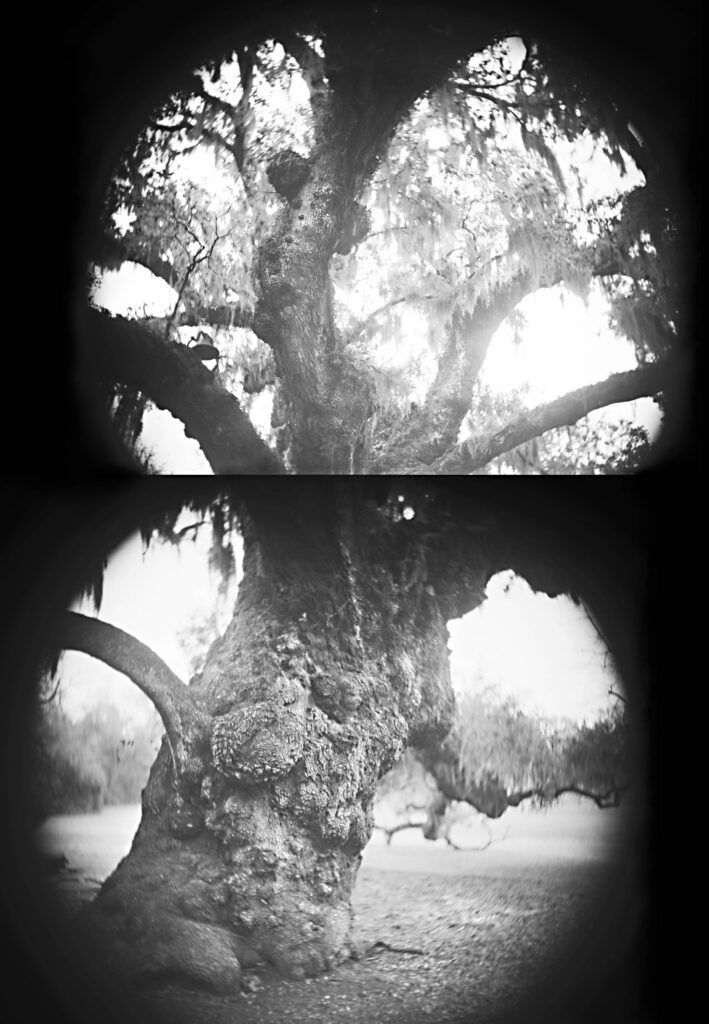
I was first drawn to Signs of Resilience due to its title, which, I find, provides the work with a sense of intrigue and complexity. Created in 2018, this piece is one of several works by contemporary artist Linda Foard Roberts the Collection. Born in 1961, Linda Foard Roberts is an American photographer and printer. She received a Master’s Degree in Fine Arts from Arizona State University and a Bachelor’s Degree in Fine Arts from Virginia Intermont College.
In Signs of Resilience, Foard Roberts challenges typical artistic and photographic conventions to create a work which is striking and memorable. Namely, she subverts the typical practice of portraying a landscape through a horizontal composition, instead choosing a vertical format. Further, Foard Roberts renders the work in black and white, one of her common practices which helps define her chosen style when presenting nature. This is a particularly interesting manner of depicting a natural landscape, as this tree’s sizeable trunk and countless leaves are such that one would perhaps expect to see the green and brown hues associated with this realm.
Additionally, Foard Roberts challenges conventions through two other aspects of her composition. Firstly, both the upper and the lower portions of the work seem to be encroached upon by darkness, which takes on a roundness and seems to be consuming the depiction of the tree which comes through underneath. Secondly, Foard Roberts divides the composition horizontally; a thick black stripes splits the bottom and the top half of the work. The stump and lower portion of the tree occupy the lower half of the composition, while the highest branches of the tree occupy the top half. This evokes a somewhat startling quality, exacerbating the ominous atmosphere created by the dark circles. In creating this detachment, Foard Roberts challenges the viewer’s conception of a tree as tall, stately, and continuous.
Ultimately, Foard Roberts subverts typical conventions of landscape photography through Signs of Resilience. Through employing a vertical composition, incorporating atypical shadow, and splitting a typically unified image, she urges the viewer to consider nature in an unconventional manner.
– Heidi McGannon ‘26